
Most travel itineraries fail for one simple reason: they optimise for places, not for people. A realistic itinerary should understand how travellers actually move, recover, eat, transfer, walk and experience a destination throughout the day.
At Yanvara, travel planning starts with structure before recommendations. Instead of simply generating attractions and routes, the system evaluates movement, pacing, transfer load, weather, energy and travel style to build itineraries that feel calmer, smoother and more realistic to follow in the real world.
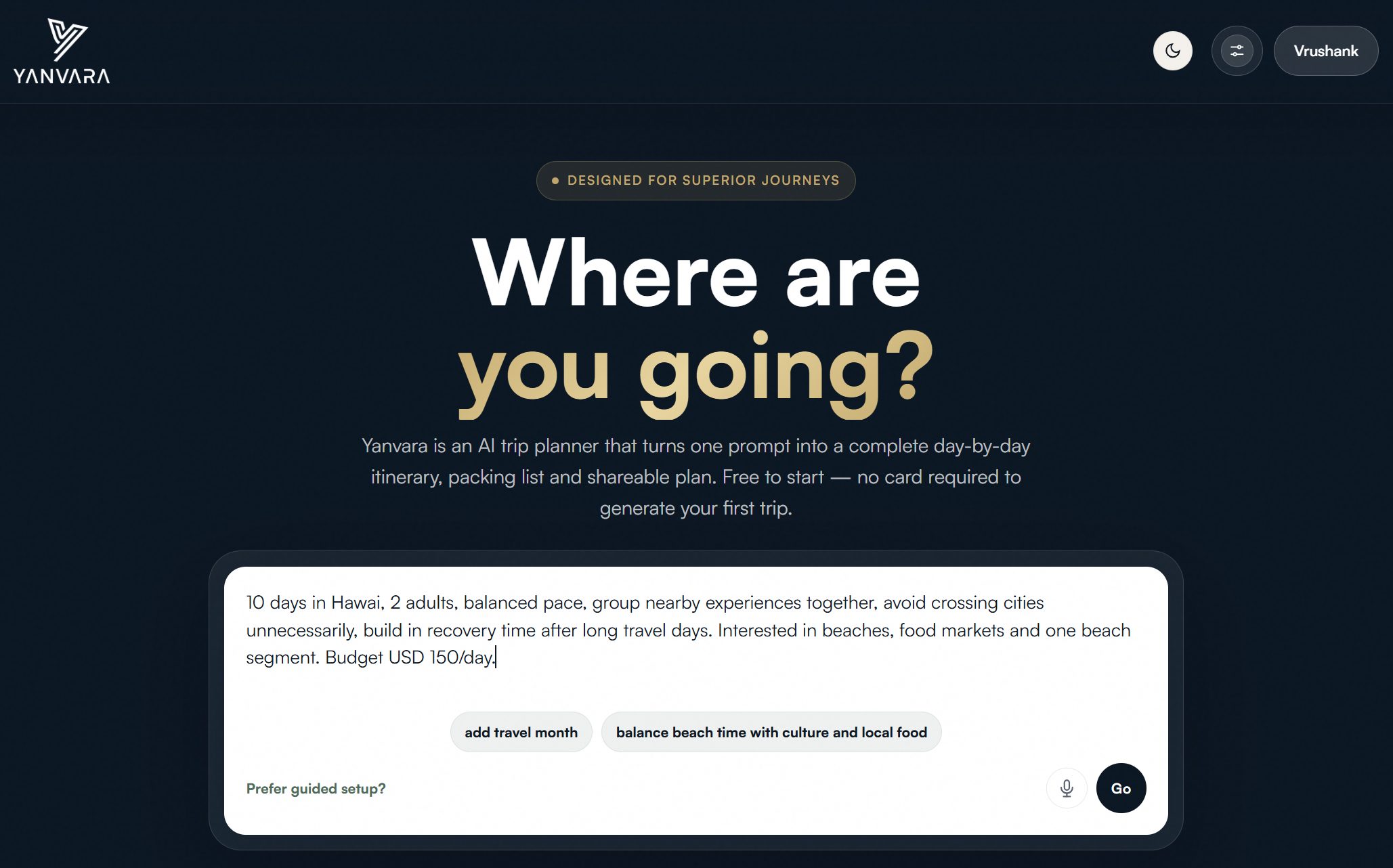
Why most travel itineraries fail
Many online itineraries are built for clicks instead of usability. They stack landmarks together without considering hotel transitions, transfer timing, walking fatigue, traffic conditions, transport changes or recovery windows.
This creates plans that look exciting on paper but become exhausting once the journey actually begins.
A traveller might technically visit eight attractions in one day, but if the experience feels rushed, stressful and physically draining, the itinerary has failed regardless of how many places were completed.
A premium itinerary is not measured by how many places are included. It is measured by how smooth and enjoyable the journey feels while travelling through them.
Real travel planning should protect energy, simplify movement and reduce unnecessary friction across the entire journey.
Start with real travel constraints
Before selecting attractions or building daily plans, the itinerary should first understand the travellers' real-world constraints.
This includes:
For example, a luxury Maldives honeymoon should prioritise slower transitions, recovery time and sunset pacing, while a Japan rail itinerary may focus on transfer efficiency, station access and clustered neighbourhood movement. For guidance on structuring your adventure in specific destinations, see our Hokkaido, Japan travel guide, South Island, New Zealand travel guide, or The Azores, Portugal travel guide.
The structure of the trip changes before the recommendations themselves change.
Plan around movement, not popularity
One of the biggest mistakes in travel planning is organising days based on famous attractions instead of geographical and physical movement.
Realistic travel planning should group nearby experiences together to minimise unnecessary transfers and reduce energy loss throughout the day.
For example, a Tokyo itinerary should avoid crossing the city multiple times simply because two trending attractions appear on social media lists. Instead, the route should flow naturally through connected districts and nearby experiences. If you're planning a multi-city trip in Japan, we also recommend checking out our Japan (Tokyo, Kyoto & Osaka) travel guide for practical route sequencing.
This becomes even more important for:
- Family travel with children
- Senior travellers
- Multi-city journeys
- Rail-based itineraries
- Luxury pacing itineraries
- Trips with weather-sensitive activities
Reduce friction and traveller fatigue
Premium travel experiences are often defined by what travellers do not notice.
Shorter walking transfers. Cleaner hotel transitions. Better check-in timing. Smarter route flow. Reduced luggage movement. Better airport sequencing.
These invisible optimisations dramatically improve how a trip feels in practice.
Yanvara approaches itinerary planning as travel infrastructure rather than simple recommendation generation.
Good travel planning reduces decision fatigue before the traveller even notices it.
A realistic itinerary should know:
- When travellers need recovery time
- When weather risk increases
- When walking load becomes excessive
- When transport changes become inefficient
- When a hotel move creates unnecessary friction
- When activities compete for energy in the same day
This is where intelligent travel planning becomes more valuable than generic destination lists.
Connect packing to the itinerary
Packing should never be treated as a separate task from planning.
The itinerary itself should influence what travellers carry throughout the journey.
Weather conditions, walking intensity, transport mode, dining plans and activity type should directly shape the packing system.
This is especially important for:
- Carry-on-only travellers
- Multi-city itineraries
- Family travel
- Winter travel
- Luxury resort transitions
- Long-haul journeys
At Yanvara, the itinerary, packing flow and travel rhythm are designed to work together instead of operating independently.
Use AI refinement properly
Most AI travel tools stop after generating the first draft.
The real value of intelligent travel systems begins after the itinerary exists.
Travellers should be able to refine:
The itinerary should evolve dynamically without forcing travellers to restart planning from the beginning.
This creates a calmer and more premium planning experience.
The future of intelligent travel planning
The next generation of travel planning is not about generating more information.
It is about creating better travel systems.
Future travel infrastructure should connect:
- Itinerary planning
- Route sequencing
- Packing intelligence
- Traveller energy management
- Movement optimisation
- Weather adaptation
- Transfer logic
- Travel refinement
That is the direction Yanvara is designed around.
Instead of overwhelming travellers with endless recommendations, the goal is to create journeys that feel more structured, more intelligent and more enjoyable to experience in the real world.