
European rail travel is one of the great ways to move through a continent — and one of the most confusing to plan from scratch.
Pass or point-to-point? Mandatory seat reservations on top of pass travel. Night trains that sell out months ahead. Border crossings with different ticketing systems. High-speed routes where booking early saves USD 80 per leg, and scenic routes where the journey is the whole point.
AI handles the routing logic so you can focus on where you actually want to go.
Eurail vs Interrail vs point-to-point
The first decision in European rail planning is whether a pass makes sense for your route — and which one applies to you.
Both Eurail and Interrail let you hop between countries without buying individual tickets for each leg. Point-to-point tickets — bought directly with operators like SNCF, Deutsche Bahn or Renfe — are often cheaper when your route is fixed and booked with advance notice.
A rail pass makes sense when your route is flexible, you'll take many trains, or you value the freedom of last-minute decisions. For a fixed route booked in advance, point-to-point tickets usually win on price.
Best rail routes in Europe
Europe's rail network is extensive, but a handful of routes stand out — either for the scenery, the speed, or the practical value they add to a multi-country itinerary.
- Paris → Amsterdam: Thalys high-speed, 3.5 hours. One of the great European rail connections — city centre to city centre, no airport friction.
- Zurich → Interlaken → Milan: The Gotthard Panorama Express. Extraordinary Alpine scenery through the heart of Switzerland.
- Vienna → Salzburg → Munich: Classic Central European corridor. All high-speed, consistently beautiful countryside.
- Barcelona → Madrid: Spain's AVE network is excellent — fast, comfortable and affordable with advance booking.
- Night train: Vienna → Venice: ÖBB Nightjet overnight service. Cabin or couchette, saves a hotel night and arrives in Venice in the morning.
- Prague → Kraków: A less-travelled corridor that connects two of Central Europe's most compelling cities with minimal fuss.
What AI handles for you
European rail routing has a lot of compounding variables. AI structures these into a coherent plan rather than leaving you to resolve them across six different booking platforms.
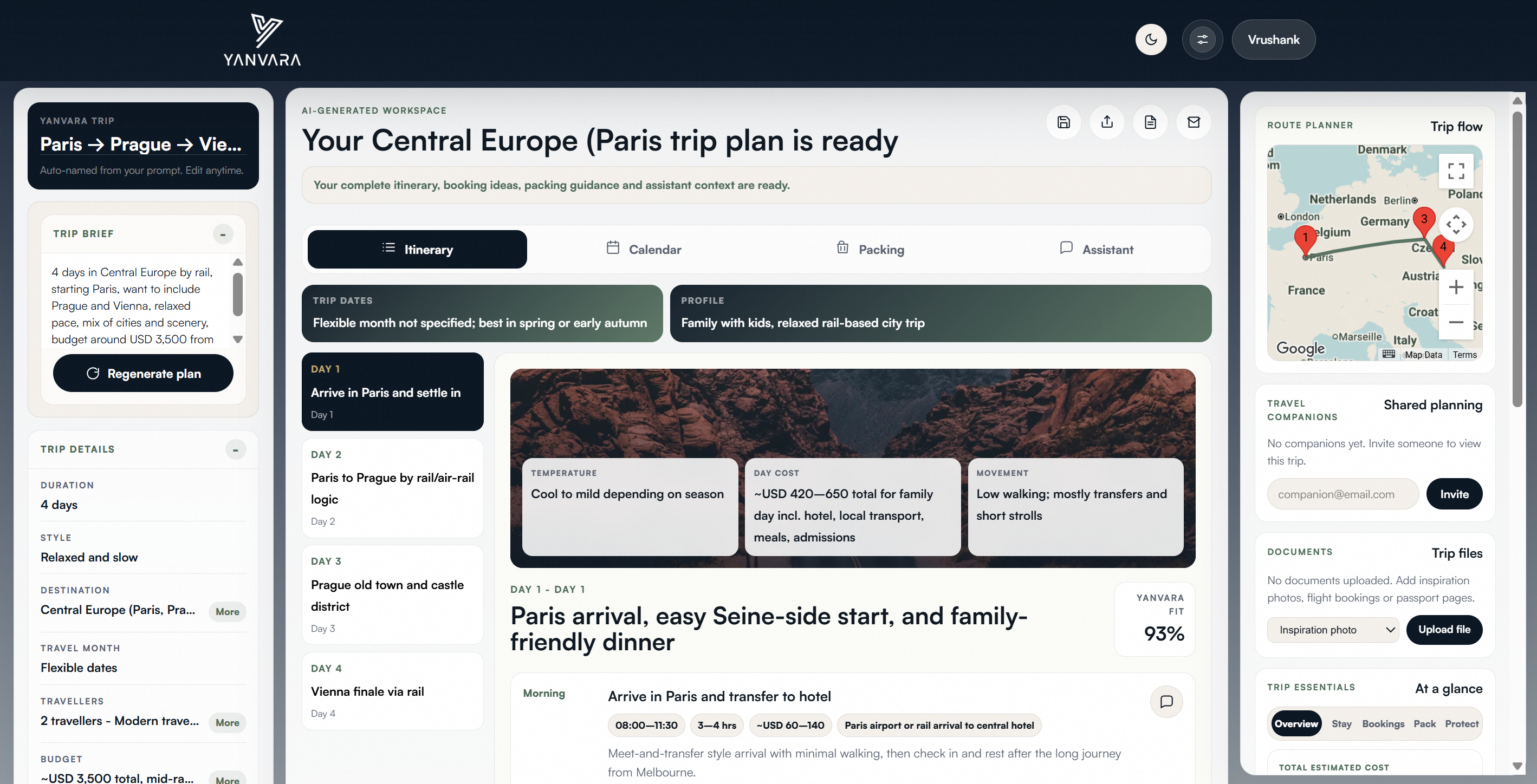
A prompt like "14 days in Central Europe by rail, starting Paris, want to include Prague and Vienna, relaxed pace, mix of cities and scenery, budget around USD 3,500" produces a routed day-by-day itinerary with transport logic built in — not a list of cities you then have to sequence yourself.
In Yanvara, you can then refine any leg through itinerary chat — swapping a high-speed route for a scenic one, adding a night train, or adjusting connection times — without rebuilding the whole plan.
Booking tips
European rail has a few hard rules that trip up first-timers. Getting these right early saves both money and stress:
- Book high-speed trains at least six weeks ahead for the cheapest fares — prices on routes like Paris–Amsterdam or Barcelona–Madrid increase significantly closer to departure.
- Night trains book out weeks in advance in summer. The ÖBB Nightjet cabins go first — book as soon as schedules open, typically three to six months out. For popular dates in 2024, look to book as soon as possible.
- Use Omio or Rail Europe for multi-country booking in a single interface rather than navigating each national operator separately.
- Always validate your ticket before boarding in countries that require it — France and Italy in particular. Failure to validate can result in an on-the-spot fine. For more insight on Italy, see our Italy travel guide. For broader trip planning help, see our Best AI Trip Planner travel guide.
- If travelling with a rail pass, check reservation fees before assuming the pass covers everything. On some high-speed routes the mandatory reservation adds USD 15–40 per leg.
The difference between an expensive European rail trip and an affordable one is almost entirely booking timing. The routes are the same — the prices aren't.