Japan is one of the most complex trips to plan — and one of the most rewarding to get right.
Forty-seven prefectures. A rail network that requires real decisions. Temple etiquette, regional food culture, cherry blossom windows that shift by a week every year. Most travellers spend 10–15 hours researching before they feel confident booking anything.
AI compresses that to a prompt. Here's how to use it well.
Why Japan is hard to plan
Japan doesn't punish bad planning — it just rewards good planning unusually well. The problem is the volume of decisions stacked on top of each other before you even leave.
Each decision connects to the next. Your rail pass choice affects your route. Your route affects your pacing. Your pacing affects what you can realistically experience versus rush through.
A good Japan itinerary isn't a list of highlights. It's a sequenced route built around realistic movement and the right amount of time in each place.
The one-prompt method
The most effective way to start planning Japan with AI is to give it the full picture upfront, not just the destination.
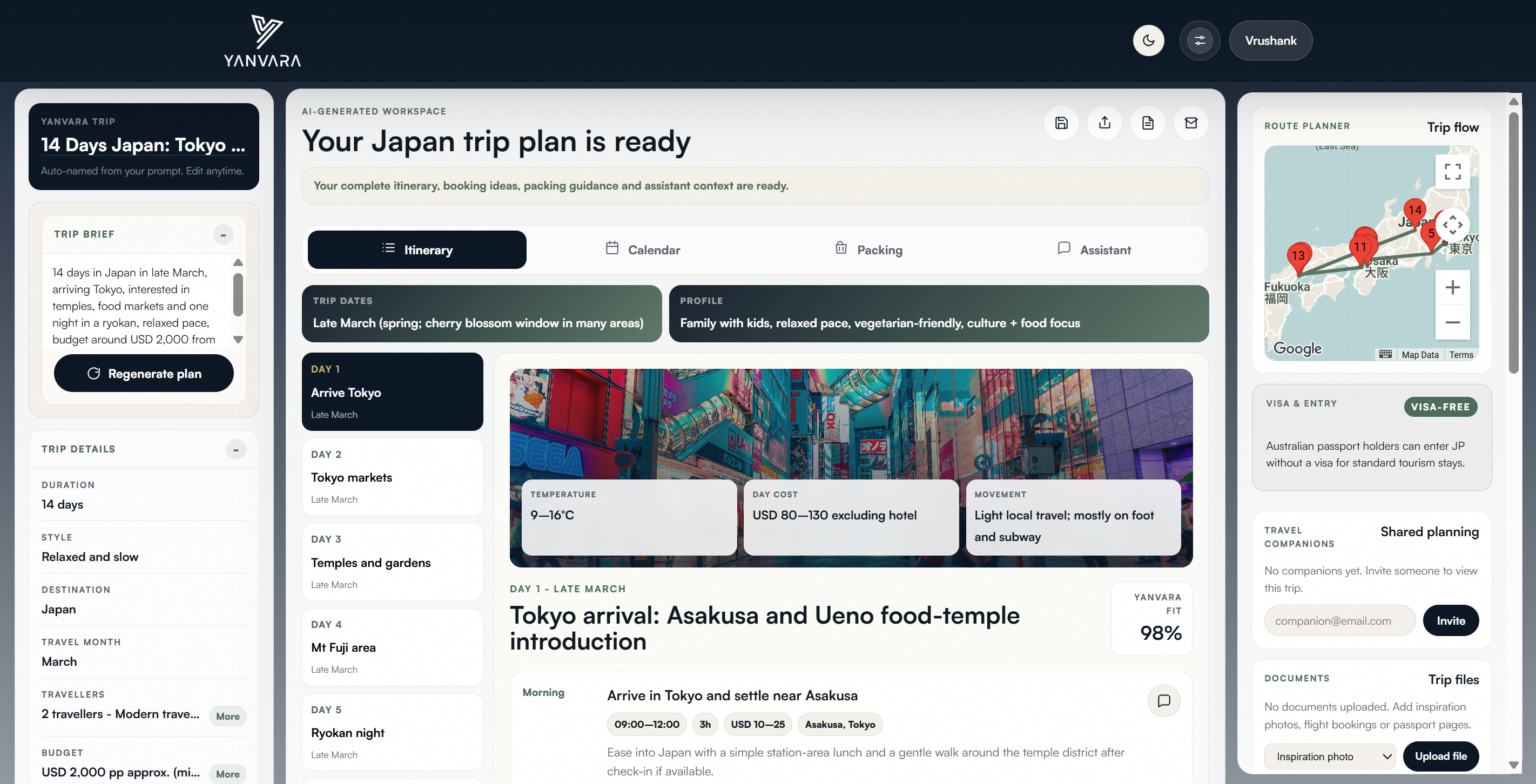
A prompt like "14 days in Japan in late March, arriving Tokyo, interested in temples, food markets and one night in a ryokan, relaxed pace, budget around USD 2,000" produces a fully routed plan — not a generic list.
The more context you give, the more precise the output. Useful variables to include:
Yanvara uses all of this to generate a day-by-day itinerary matched to your travel style — with pacing, route logic and a packing list built in. You can then refine any part of it through itinerary chat without starting again.
Sample 14-day Japan route
This is a balanced 14-day structure covering three core regions. Adjust based on your pace preference and interests.
- Days 1–4: Tokyo — Shibuya, Shinjuku, Asakusa, Tsukiji market, day trip to Nikko or Kamakura.
- Days 5–6: Hakone and surrounds — Ryokan, Mt Fuji views, onsens, Hakone Open Air Museum.
- Days 7–9: Kyoto — Arashiyama, Fushimi Inari, Nishiki Market, Gion evening walk.
- Days 10–11: Osaka and Nara — Day trip to Nara (deer park), Osaka street food, Dotonbori.
- Days 12–13: Hiroshima and Miyajima — Peace Memorial Museum, Itsukushima shrine at low tide.
- Day 14: Return to Tokyo — Shinkansen back, evening in Ginza or Akihabara.
Rail pass decisions
The JR Pass question is one of the most searched topics in Japan travel — and the answer depends entirely on your route.
As a rough guide: the JR Pass starts to make financial sense around ¥50,000 of Shinkansen travel. For a Tokyo–Kyoto–Hiroshima–Tokyo loop, it typically pays off. However, recent JR Pass price increases mean it is usually only worth it for longer or more extensive multi-city routes. For a Tokyo–Osaka trip only, buying individual tickets or using IC cards is often cheaper.
When you generate a route in Yanvara, the itinerary structures your movement so you can assess pass value against your actual planned travel — rather than guessing upfront.
Booking tips
Japan has a few hard booking rules that catch first-timers. Getting these right early removes the biggest sources of trip friction.
- Book ryokans 3–4 months ahead for peak season (March/April, October/November).
- Reserve popular restaurants at least a week in advance — some require months.
- Get a Suica or Pasmo IC card on arrival for local transit in every city.
- Download Google Maps offline maps for each prefecture before you travel.
- Check cherry blossom forecasts starting in late January — timings vary each year, commonly peaking between mid-March and early April in Tokyo and Kyoto. See how season can change your travel experience in Portugal.
The travellers who enjoy Japan most aren't the ones who planned every hour. They're the ones who got the foundations right and left room to wander.